EXHIBITION of student works focused on giving value to process and facilitating viewer engagement through virtual platforms .
VIRTUAL EXHIBITIONS
Virtual art exhibitions undoubtedly have their limitations, but there are also potential capabilities that these formats support that should be explored. This past year I worked toward investigating the ways in which online exhibitions of student works could give value to process, celebrating the thinking that has unfolded behind a student’s works alongside the actual finished product, facilitate new forms of engagement between student-artists and viewers as well as welcome interaction from a community that has historically been quite absent from any onsite exhibitions we have had at school – the parent body.
G10 Online Art Exhibition – SEA CHANGE
At the end of quarter one our school opted to host an online activity day for students where they were invited to log on and engage in various activities ranging from karaoke and portrait booths to trivia challenges and chess matches. I decided that the day could be a great opportunity to show off some recently-completed student work, and dove into the development of an online art gallery for the G10 Art Students’ Unit 1 Sea Change project.
This project invites students to explore the concept of identity through the creation of three unique images, 1- visualizing a moment in the past when they felt like they were truly themselves, 2- focusing in on the present moment by asking them to render an image of how they see themselves today and 3- looking to the future and utilizing imagination to create an image representing who they want to become. Students ultimately collage these three works together into one final art piece, creating a self-portrait that depicts not only what they look like but also who they are.
Leading up to the project students are asked to participate in a warm-up brainstorm activity where they create a selfie that includes a “hashtag statement” written out on paper and made visible in the photograph. The statement completes the following 3 prompts: #I have been…#I am… and #I will be…
These actives are aimed at drawing the students attention to the ways in which our experiences inform the ways we view ourselves and others, as well as consider the possibility of Identity being a far-from-static and even fluid aspect of who we are that, like a Sea Change, can grow and evolve with the ebb and flow of life.
Students are ultimately asked to document the creation of their work in a short video, utilizing the potential of time-based media to not only share an image of their completed artwork but also the story behind each of the three pieces incorporated into its composition and the ways in which these past, present, and future aspects of their identity interact with and influence one another.
In an effort to highlight these thinking processes and preliminary activities alongside the finished artworks, I selected a handful of student works to be showcased within the G10 Sea Change online exhibition. I utilized Google Sites to create an online platform that could support and share not only images of their completed portraits but also the videos sharing their stories and the selfie-photos used to workshop through their initial brainstorms. I very intentionally tried to present these three diverse aspects of the project in a way where each was given equal importance as the other within the site layout – letting the warm-up selfie and the reflection video share the stage with the completed artwork in a way that refuted any sort of hierarchy amongst them.
Last but definitely not least, the website also invited viewer-engagement in its request for comments that could be made and submitted through google forms and delivered to each specific artist. Viewers who left thoughtful and complete comments for the artists were rewarded with learner development hours as way of acknowledging their participation.
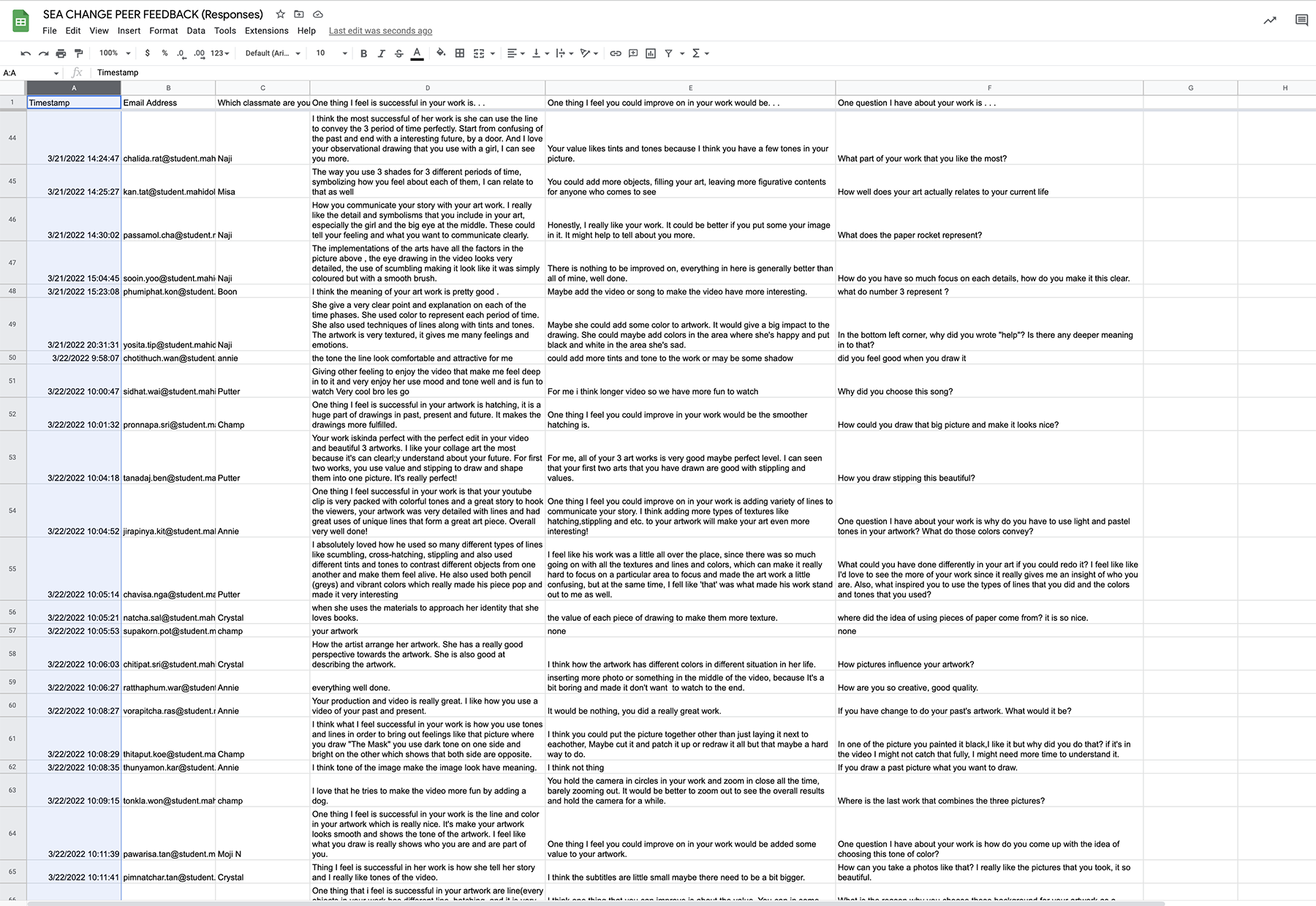
Visit the Sea Change Exhibition here: here:https://sites.google.com/mahidol.edu/seachange2021/home
AP ART EXHIBITION
Covid has, for the third year in a row now, squandered my plans for an onsite AP Art exhibition. 2020 sent us home for online learning just before the student’s portfolios were completed, 2021 brought us back on site just in time to throw a few things up on some bulletin boards but, in all honesty, without much time for planning or any very thoughtful curation of the content within the space and this year, 2022, left us stuck online for pretty much the duration of the year. Nonetheless, I decided that this year the AP Art Exhibition must go on and investigated opportunities to utilize online platforms for its realization.
As we had been utilizing the Gathertown platform as a host for the virtual art room all year, it seemed best to try to stick to this format and take advantage of the fact that the students were already familiar with it and would be best able to envision how their works could potentially be exhibited within a Gathertown space.
After discussion and sharing of our hopes for the exhibition layout, we decided to go with a “white cube” design as the online format was, in itself, unconventional enough and something “familiar” could potentially foster more effective user engagement with the work.
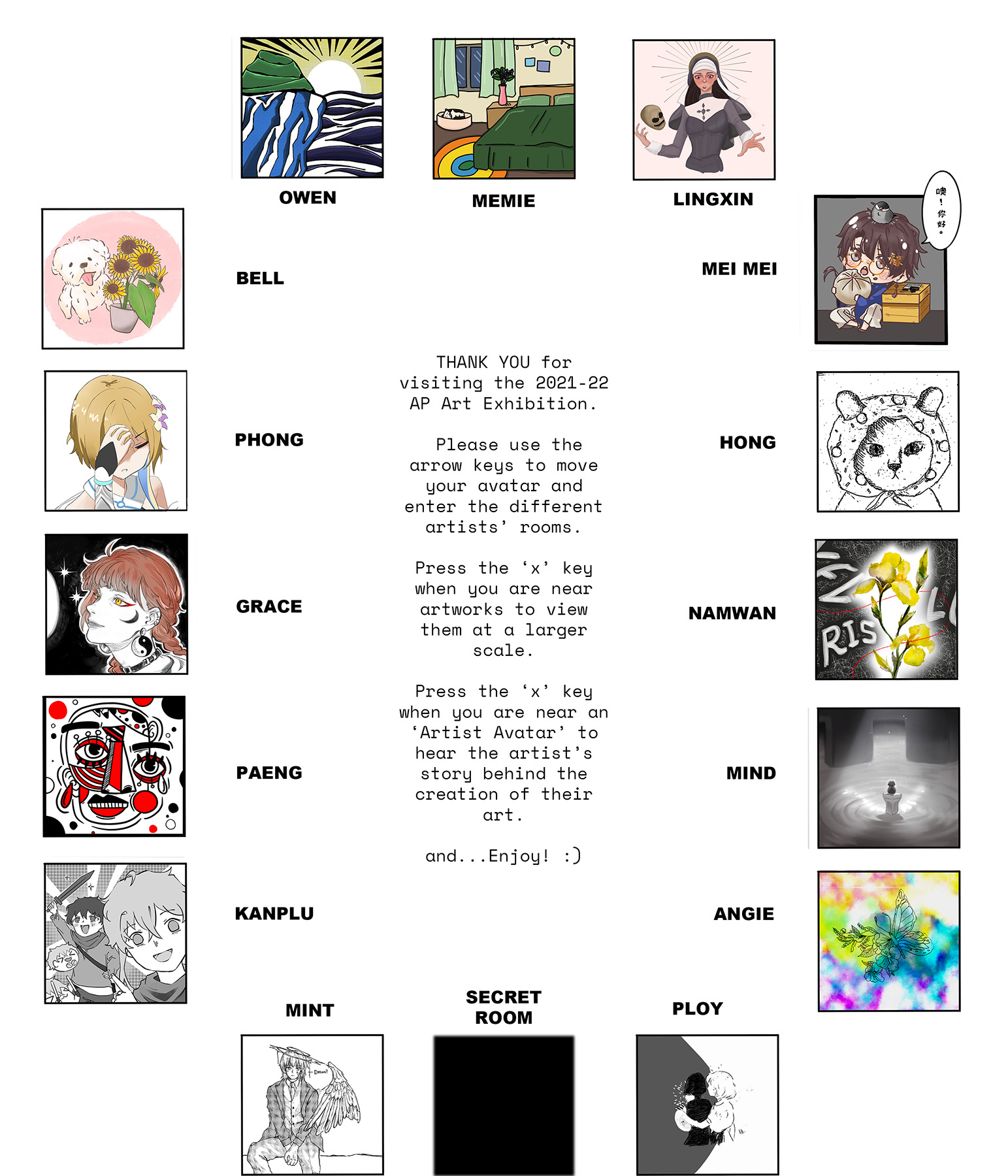
We drafted up a space that housed a separate room for each student’s work and all were invited to place their five selected works within their designated gallery. Set within each room was also stationed an “artist avatar” that could be interacted with by visitors to the exhibition. If a visitor to the space were to walk up to an artist avatar and elicit interaction with them, they would find themselves provided with a short, student-created video clip, welcoming them to the exhibition, introducing themselves and sharing both the physical processes regarding what materials and techniques they had used to create their art as well as the thinking processes behind the development of their works.
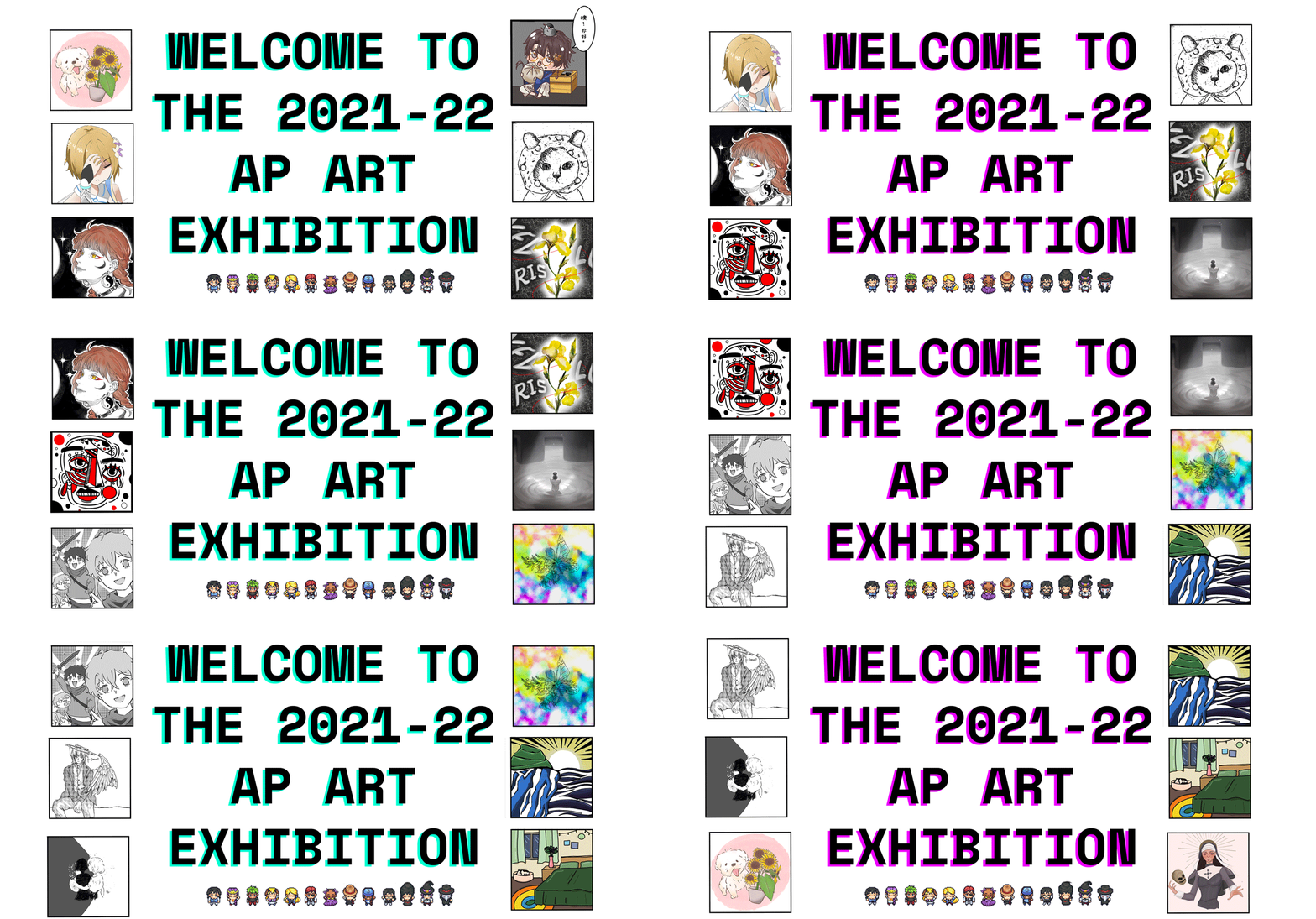
Last but not least – we invited everyone! I reached out to the Gathertown platform directly and was successfully awarded a discounted upgrade to our space, allowing for the supported attendance of up to 50 virtual visitors at once. This upgrade allowed for us to confidently use “news” platforms we already had in place (such as our MUIDS homeroom hub) to extend our invitation to the exhibition opening party to both students and teachers alike. We also worked with our very helpful teaching assistant, Ms. Jaijai to create a parent-friendly invite sharing information for how to access the exhibition in both English and Thai languages. These invites were distributed to parents via email and I was very happy to see that doing so resulted in the attendance of several artist-parents to the online exhibition space during the Opening Party.
Visit the AP Art Exhibition here:
https://app.gather.town/app/
*best viewed on a desktop
REFLECTION
Exhibition of student work is something I often, unfortunately, run out of time for investigating in a truly creative or novel way and throwing some student works up on a bulletin board with the unit title above is often as far as I can get. I do, however, acknowledge that the benefits of showing student work are significant – not only for the artists but also the viewers – and am hopeful that this is an area I can continue to improve on. One takeaway I have following the experience of showcasing student works in a virtual setting is that these digital formats can not only showcase the work effectively, but also provide means for visitors to engage directly with the artists (whether they are “there” or not) via comments and interactive objects and, furthermore, provide a second function of acting as a source of documentation of the work. While a physical exhibition held in the school has its own benefits, it will eventually be taken down and can only be documented in photograph. Online exhibitions, in contrast, can be “open” indefinitely, and provide additional means for sharing their content with audiences like the parent body who may not typically have time on the given exhibition day to stop by school and see their child’s work. With the online format, these works can be celebrated any day, and from anyplace with Internet connectivity and that is certainly a benefit worth recognizing, and perhaps taking with me, as I move forward to explore exhibition of student works in the future.