Capstone Project

LDT400x

Minicourse Features & LMS Declaration

Instructional Design Document (IDD)

My minicourse, “Art as Agency,” is a high school-level course designed to integrate foundational art skills with the United Nations Sustainable Development Goals (SDGs). The full Instructional Design Document can be accessed from the tab above or here: https://rybcmyk.rebeccavickers.com/instructional-design-document/

Minicourse Features

Learners in the “Art as Agency” minicourse can expect the following features:

  1. Project-Based Learning Modules: The course is structured around three core hands-on projects. Each project module will challenge students to create a specific piece of art (a zine, an awareness campaign, a community map) that directly addresses a specific UN Sustainable Development Goal. I am not sure that I will complete all modules for this Capstone course, I intend for them to function as stand-alone classes as well but will see how many I can create in the time that we have.
  2. Collaborative Peer Critique Hubs: Peer critique is one of the most valuable aspects of a learning environment when studying art. To foster a collaborative studio environment online, the course will feature some structured peer feedback activities. In key project modules, students will share their works-in-progress and use guided questions to provide constructive feedback to their classmates, even if asynchronously.
  3. EFL-Centered & Accessible Content: Acknowledging that many students are English as a Foreign Language (EFL) learners, all instructional content will be designed with their needs at the forefront. This UDL-inspired approach includes providing video lectures with clear captions and downloadable transcripts, offering optional sentence-starters and vocabulary banks for written assignments, and using visuals heavily to support textual information.
  4. Artist & Activist Spotlights: To provide real-world context and inspiration, each module will feature a short, curated profile of an artist or activist whose work addresses the relevant SDG. This feature will reinforce the concept of “agency” by showing students tangible examples of how art can be a powerful tool for social change.


LMS of Choice: Google Classroom

My chosen LMS for the “Art as Agency” minicourse is Google Classroom. This decision is based on several key factors. Firstly, Google Classroom is the platform currently used at my school. While I am familiar with it, there are many new resources and aspects of the GC that I have yet to explore. Through the creation of my minicourse via this LMS, I will be able to learn how to use the new features and tools, which will directly benefit my daily teaching practice. Beyond these practical reasons, the platform itself is ideal for the course; its seamless integration with Google Workspace and user-friendly design are perfect for a project-based course that emphasizes student creation and the sharing of their work.

The elements of Google Classroom that best support my minicourse are:

  • Google Drive Integration: This is the most critical feature for my course. Students can easily create, manage, and submit their artwork and written components using Google Docs, Slides, and Sheets. Students can also use Google Drive folders or even Google Sites to build and share their digital portfolios.
  • The “Classwork” Page: I can use the “Topics” feature on the Classwork page to organize the course into the distinct project-based modules. This creates a clear and simple learning path for students to follow. Students could choose to engage with one topic or many.
  • The “Question” Feature: This feature can be used to facilitate Peer Critiques. I can use the Question feature to create a dedicated space for each critique, allowing students to post links to their work and reply to each other’s posts with feedback.
  • Simplicity and Accessibility: Google Classroom’s interface is clean, intuitive, and mobile-friendly, which reduces the cognitive load on students and aligns with UDL principles. Many high school students are already familiar with it, making it easy to get started.

Google Classroom Support Resources

To support the development of my course in Google Classroom, I have identified the following two key training resources:

  1. Google for Education Teacher Center: This is Google’s official hub for educator training. It contains free online courses, product guides, and lesson plans for every tool in the Google Workspace for Education, including an extensive section on Google Classroom. It provides fundamental training as well as advanced strategies.
  2. “Shake Up Learning” by Kasey Bell: This is a highly respected blog, podcast, and YouTube channel run by educator Kasey Bell. It provides practical, creative, and teacher-tested tips for using Google Classroom and other Google tools in an educational setting. It’s an excellent resource for finding innovative ways to engage students beyond the basic features.
Art as Agency: End-of-Course Survey

Below is the a Kirkpatrick Level 1 survey created in Google Forms. This survey is designed to gauge learner reaction, engagement, and the perceived relevance of the “Art as Agency” minicourse.


Art as Agency: Knowledge and Skills Check

Below is the structure and content for a Kirkpatrick Level 2 assessment quiz created in Google Forms. This quiz is designed to measure the knowledge and skills learners should have acquired after completing the “Art as Agency” minicourse, based on the course learning outcomes.


Assessment Alignment and Instructions

This assessment is designed for the “Gender Equality Zine Project” module.

  • Course Learning Outcomes Alignment: This assessment primarily aligns with the following CLOs:
    • ANALYZE the relationship between art, social justice, and the UN SDGs.
    • APPLY art and design principles to create original work that addresses these global goals.
    • PRODUCE and PRESENT original creative work that demonstrates personal agency.
  • Module Learning Objectives Alignment: Upon completing this module, learners should be able to:
    • Define the key characteristics of a zine as a form of personal expression.
    • Identify connections between the UN SDG for Gender Equality and the work of featured artists.
    • Explain the concept of “agency” as it relates to creating art for social change.
  • Learning Materials and Activities: Before taking this assessment, learners will have interacted with video lectures on zine history and design principles, reviewed “Artist & Activist Spotlight” profiles, participated in a peer-critique discussion, and completed their own zine project on the theme of gender equality.


Reflection

The process of creating this Kirkpatrick Level 2 assessment was a valuable exercise in alignment. It required me to look back at my IDD and translate the high-level Course Learning Outcomes into specific, measurable questions. Unlike the Level 1 survey, which focused on student feelings, this quiz had to target tangible knowledge and skills. For example, instead of asking if students felt a connection between art and the SDGs, I created questions that require them to demonstrate their understanding of that connection. The data from this assessment would be incredibly useful. If a significant number of students answer a question incorrectly, it would signal a misalignment between my teaching activities and a specific learning objective. For instance, if many students struggle with the matching question (#5), it might indicate I need to provide more explicit instruction on the specific artistic principles as they relate to each project. This allows me to make evidence-based refinements to the course, ensuring that future learners are not just engaged, but are truly mastering the intended skills and knowledge.

Discussion & Assignment Prompts

Course Learning Outcome(s) Alignment: The prompts in this module are designed to collectively assess the following CLOs:

  • CLO 1: ANALYZE the relationship between art, social justice, and the UN SDGs.
  • CLO 2: APPLY art and design principles to create original work that addresses global goals.
  • CLO 3: COLLABORATE with peers to provide and receive constructive feedback.
  • CLO 4: PRODUCE and PRESENT original creative work that demonstrates personal agency.

Module Learning Objective(s) Alignment: Upon completing this module, learners should be able to:

  • Define the key characteristics of a zine as a form of personal expression.
  • Identify connections between the UN SDG for Gender Equality and the work of featured artists.
  • Explain the concept of “agency” as it relates to creating art for social change.

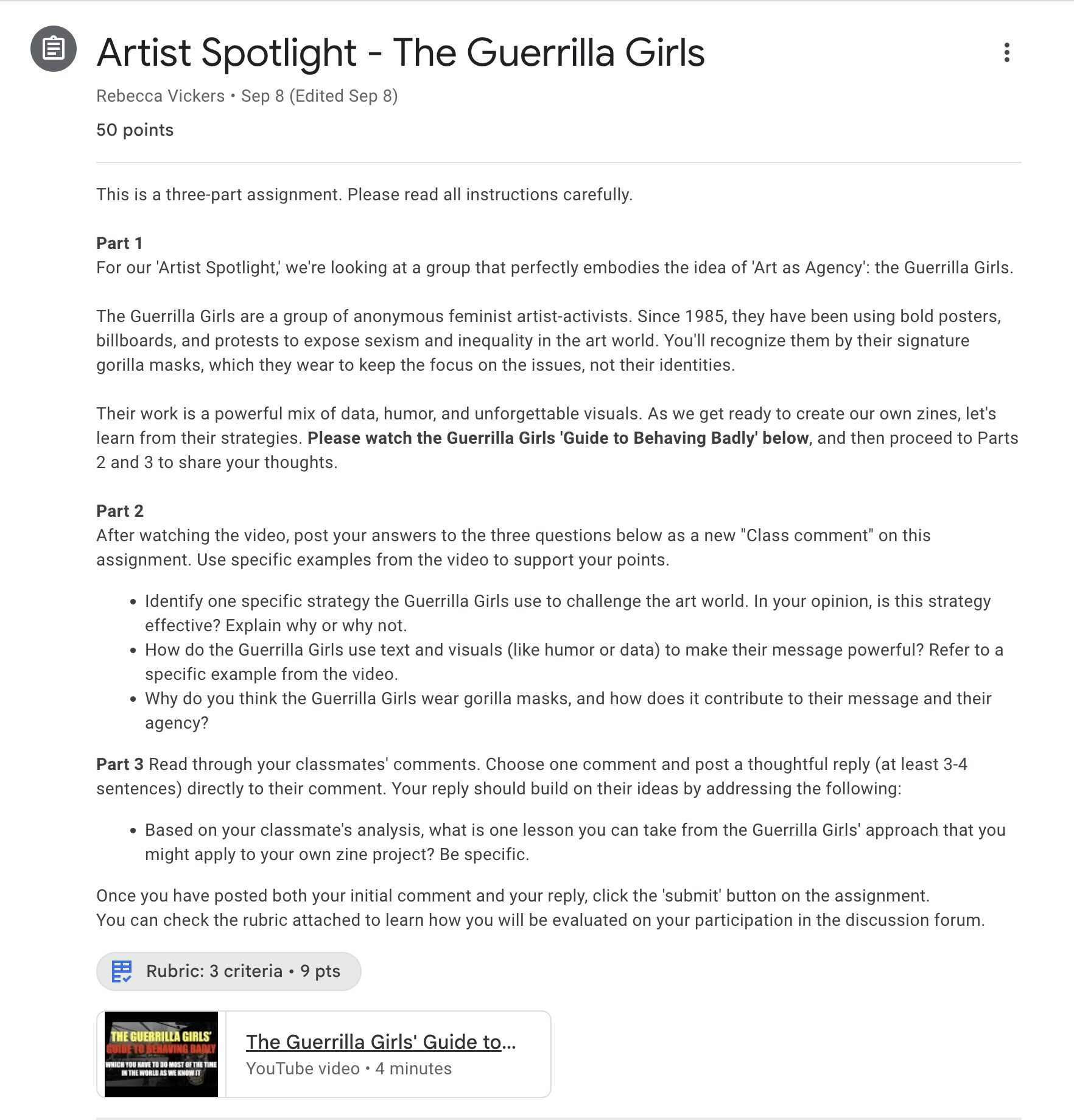
Learning Materials & Activities: Before engaging with these prompts, learners will have interacted with a welcome video, the course syllabus, an introductory video on the UN SDGs, a video on the history of zines, an infographic on inclusive language, an ethical image sourcing guide, a video on the Guerrilla Girls, and a video tutorial on how to fold a zine.


Discussion Prompts

Discussion Prompt 1: Artist Analysis – The Guerrilla Girls

Learning Objectives Assessed: This discussion assesses CLO 1 (Analyze) and the module objective of identifying connections between the SDG for Gender Equality and the work of featured artists.

  • Discussion Prompt: This is a three-part assignment. Please read all instructions carefully. Important: To create a public discussion where everyone can see and reply to each other, we will use the “Class comments” section for this assignment. Please do not submit a private Google Doc.
    1. Part 1: Your Initial Post: After watching the video on the Guerrilla Girls, post your answers to the three questions below as a new “Class comment” on this assignment. Use specific examples from the video to support your points.
      • Strategy & Effectiveness: Identify one specific strategy the Guerrilla Girls use to challenge the art world. In your opinion, is this strategy effective? Explain why or why not.
      • Visuals & Message: How do the Guerrilla Girls use text and visuals (like humor or data) to make their message powerful? Refer to a specific example from the video.
      • Anonymity: Why do you think the Guerrilla Girls wear gorilla masks, and how does it contribute to their message and their agency?
    2. Part 2: Reply to a Peer: Read through your classmates’ comments. Choose one comment and post a thoughtful reply (at least 3-4 sentences) directly to their comment. Your reply should build on their ideas by addressing the following:
      • Based on your classmate’s analysis, what is one lesson you can take from the Guerrilla Girls’ approach that you might apply to your own zine project? Be specific.
    3. Part 3: Final Step: Once you have posted both your initial comment and your reply, click the “Submit” button on this assignment.
  • Participation Requirements: Students are required to make one initial post answering three questions and one thoughtful reply to a peer. 


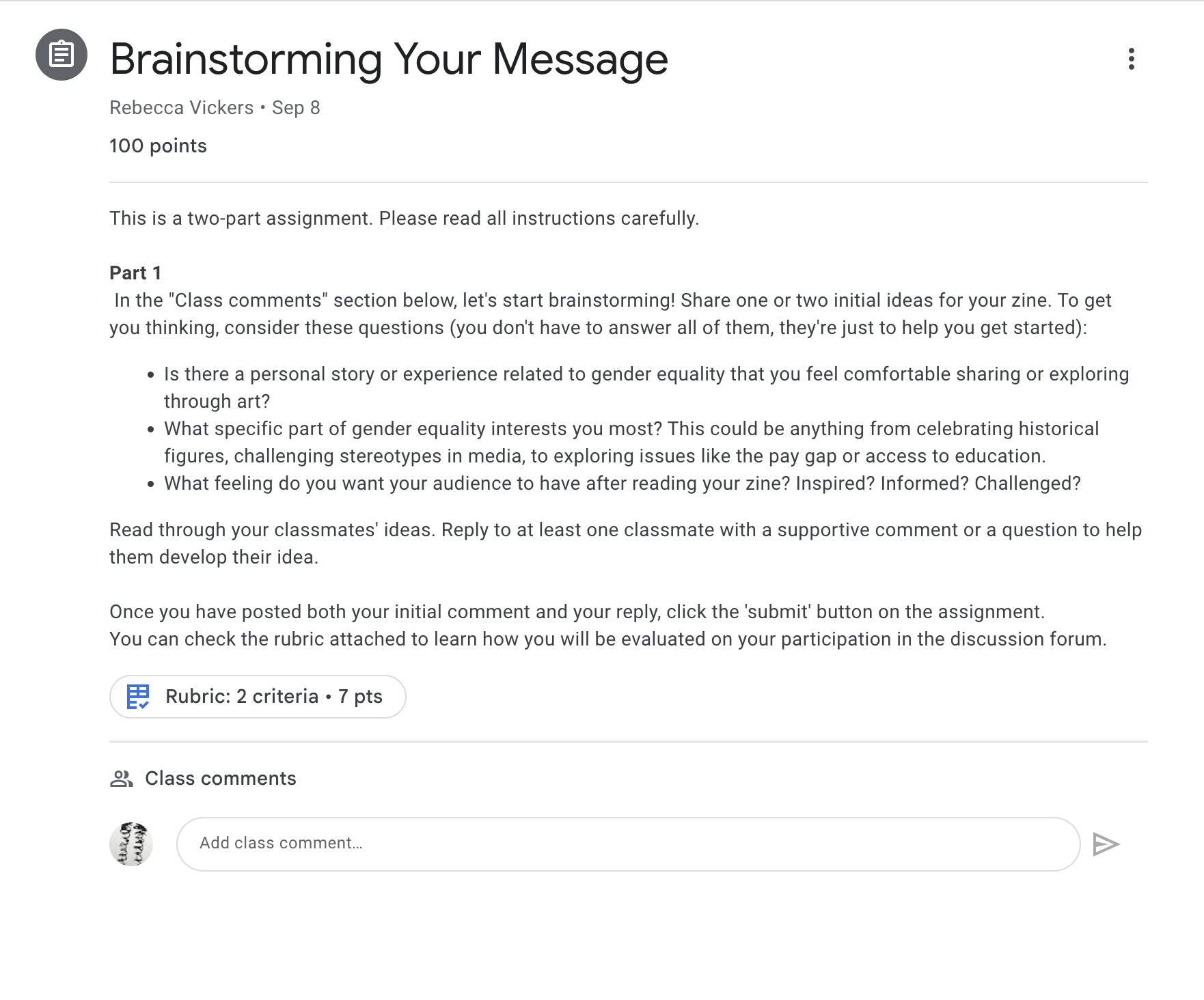
Discussion Prompt 2: Brainstorming Your Message


  • Learning Objectives Assessed: This discussion assesses CLO 3 (Collaborate) and begins the process for CLO 2 (Apply).
  • Discussion Prompt: Important: To create a public discussion, we will use the “Class comments” for this activity.
    1. Part 1: Your Idea: In the “Class comments” section below, let’s start brainstorming! Share one or two initial ideas for your zine. To get you thinking, consider these questions:
      • Personal Connection: Is there a personal story or experience related to gender equality that you feel comfortable sharing or exploring through art?
      • Specific Issue: What specific part of gender equality interests you most? (e.g., celebrating historical figures, challenging stereotypes, etc.)
      • Desired Feeling: What feeling do you want your audience to have after reading your zine? Inspired? Informed? Challenged?
    2. Part 2: Peer Feedback: Read through your classmates’ ideas. Reply to at least one classmate with a supportive comment or a question to help them develop their idea.
    3. Part 3: Final Step: Once you have completed both parts, click the “Submit” button on this assignment.
  • Participation Requirements: Students are required to post at least one initial idea and reply to at least one classmate.


Assignment Prompt

Learning Objectives Assessed: This assignment is the summative assessment for the module and evaluates CLO 2 (Apply) and CLO 4 (Produce and Present).

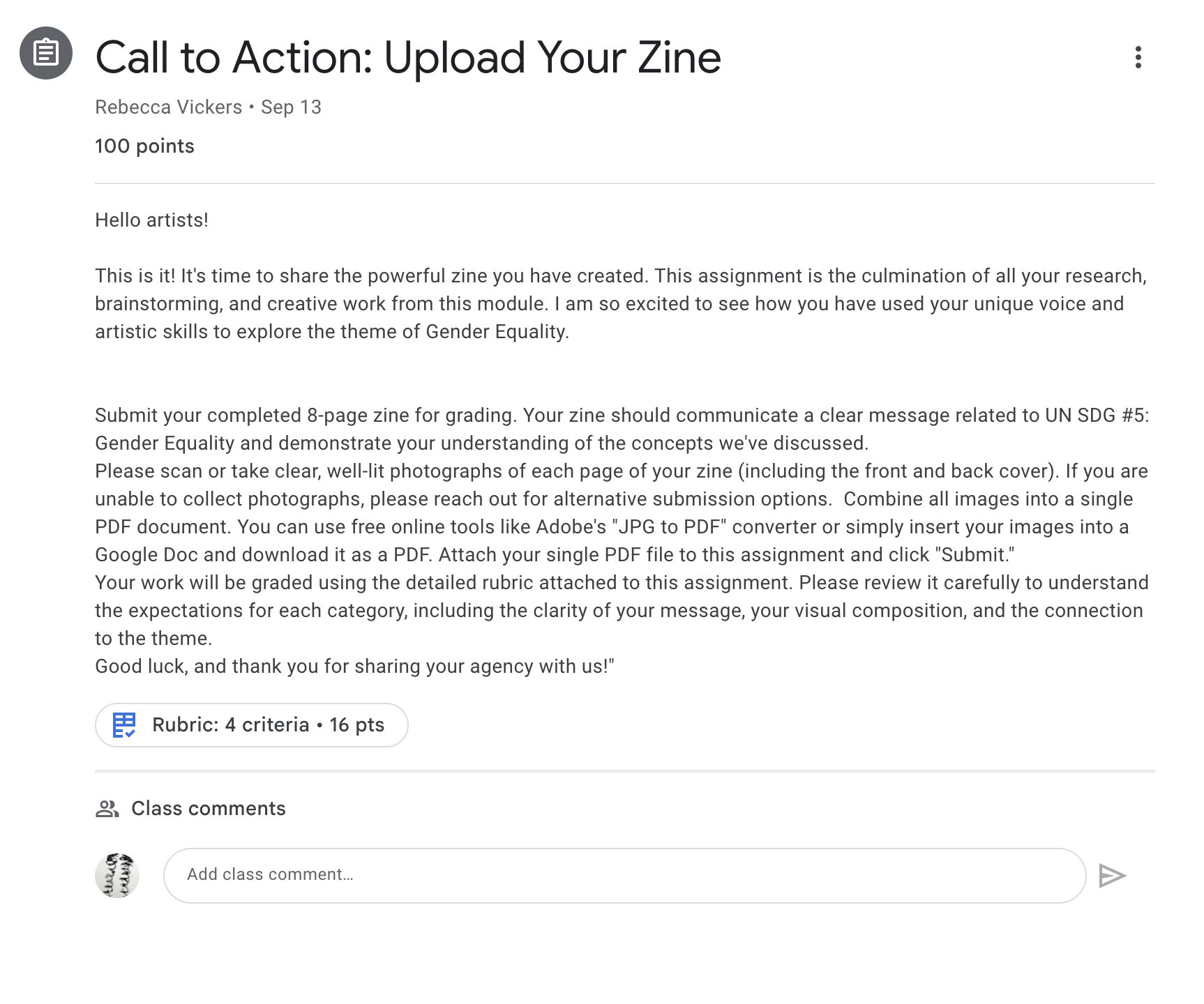
  • Description of Assignment: This is the final project for the “Gender Equality Zine Project” module. Students will create and submit a complete 8-page, handmade zine that uses a combination of text and visuals to communicate a clear message related to the UN Sustainable Development Goal #5: Gender Equality.
  • Instructions for Learners: “Hello artists, This is it! It’s time to share the powerful zine you have created. This assignment is the culmination of all your research, brainstorming, and creative work from this module. I am so excited to see how you have used your unique voice and artistic skills to explore the theme of Gender Equality.]
  • Assignment Task: Submit your completed 8-page zine for grading. Your zine should communicate a clear message related to UN SDG #5: Gender Equality and demonstrate your understanding of the concepts we’ve discussed.
  • Evaluation: Your work will be graded using the detailed rubric attached to this assignment. Please review it carefully to understand the expectations for each category, including the clarity of your message, your visual composition, and the connection to the theme.”

Guidelines for Submission:

    1. Digitize Your Zine: Please scan or take clear, well-lit photographs of each page of your zine (including the front and back cover).
    2. Combine into One File: Combine all images into a single PDF document. You can use free online tools or simply insert your images into a Google Doc and download it as a PDF.
    3. Submit: Attach your single PDF file to this assignment and click “Submit.”

Reflection

Creating these prompts was an exercise in scaffolding the learning process from abstract analysis to concrete creation. The first discussion on the Guerrilla Girls asks students to analyze existing work, which provides them with a framework and inspiration. The second brainstorming discussion then acts as a bridge, asking them to apply those analytical skills to their own ideas in a low-stakes, collaborative environment. The final assignment is the culmination of this process, allowing them to produce their own work. The information gathered from these prompts will be invaluable for course improvement. For example, the brainstorming discussion will quickly reveal if students are struggling to connect with the theme, allowing me to provide more targeted resources. The final zine submissions will be the ultimate measure of whether the activities effectively prepared students to meet the learning outcomes.

Discussion & Assignment Prompt Rubrics

The rubrics I developed are included as screenshots below. In the live course in Google Classroom, these rubrics would be built directly into their corresponding Discussion and Assignment posts.


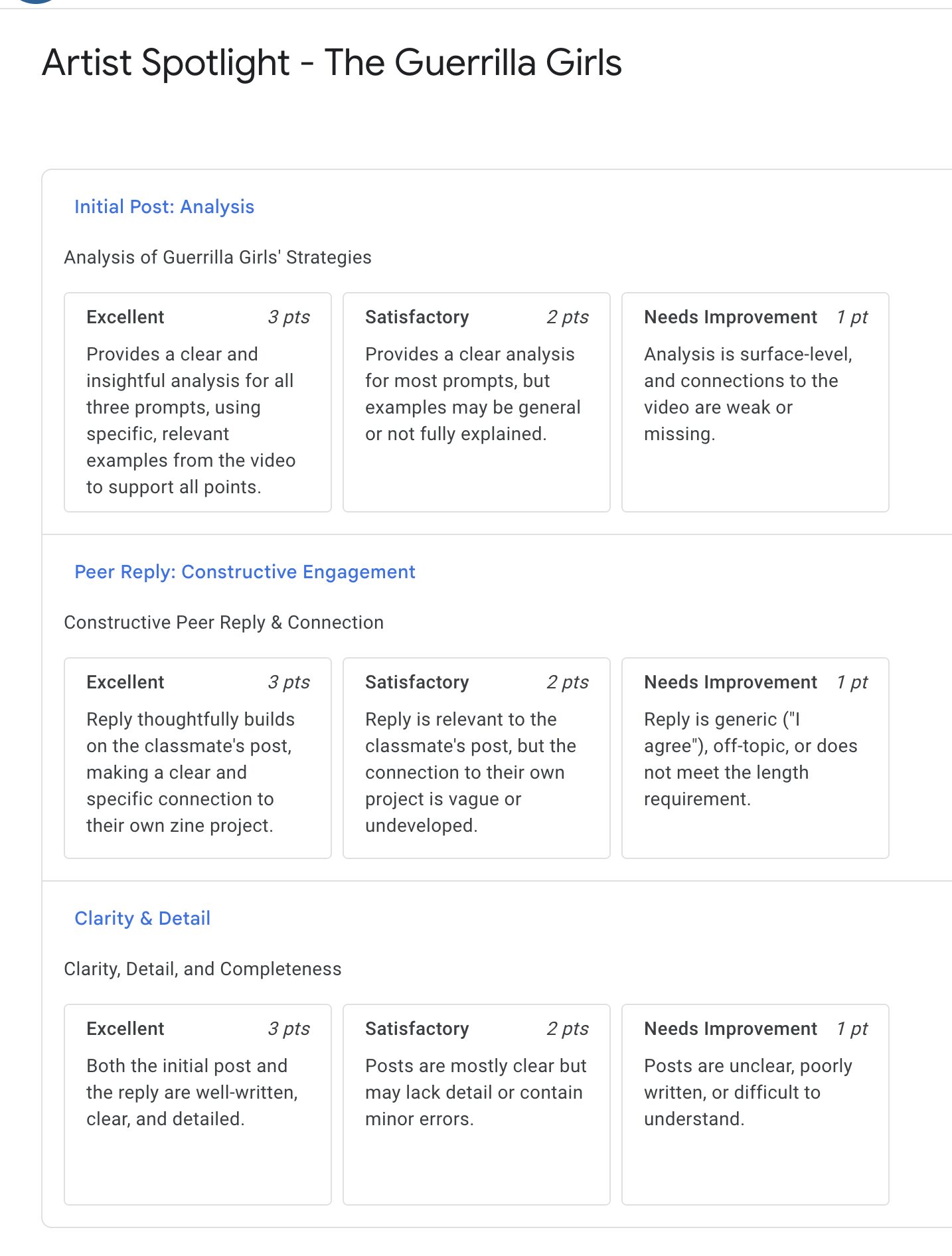
Rubric 1: Discussion Prompt Rubric

This rubric is for the “Artist Analysis – The Guerrilla Girls” discussion.


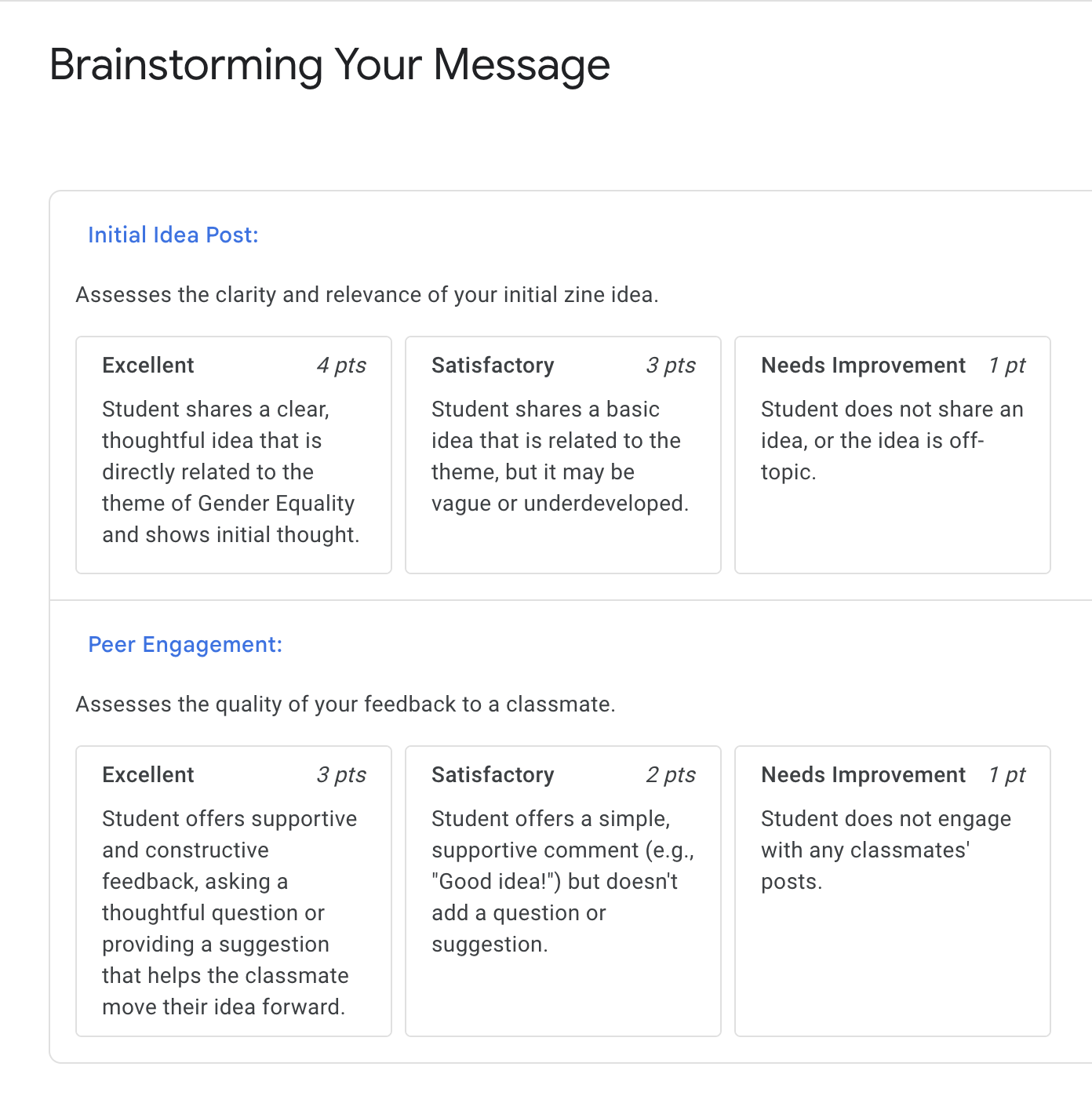
Rubric 2: Discussion Prompt Rubric

This rubric is for the “Brainstorming Your Message” discussion.


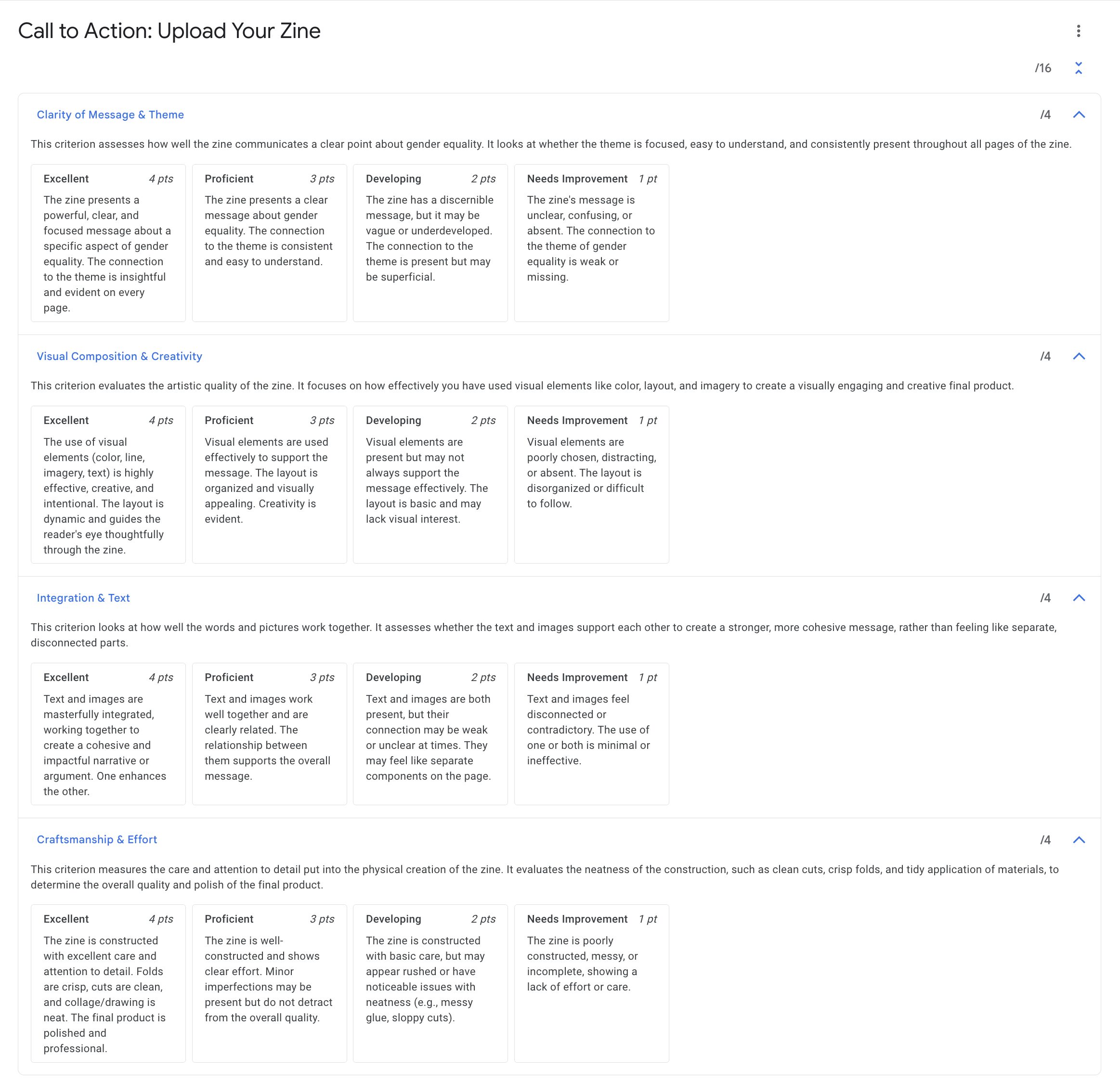
Rubric 3: Assignment Prompt Rubric

This rubric is for the final “Call to Action: Upload Your Zine” assignment.


Reflection

Creating these rubrics was an exercise in making expectations explicit and transparent for the learner. The process required me to deconstruct the goals of each activity into distinct, measurable criteria. For the discussion, the rubric prioritizes analysis and peer interaction, while the final assignment rubric focuses more on the application of creative and thematic skills. The information gathered from these rubrics is incredibly valuable for continuous improvement. For example, if I notice a trend of students scoring low on the “Integration of Text & Image” criterion in the final assignment, it’s a clear signal that I need to add more direct instruction or an additional practice activity on that specific skill in the next iteration of the module. This allows me to use assessment data not just for grading, but as a diagnostic.

Learning Theory/ Instructional Design Models & Opening Presentation


Reflection on Learning Theory

The design of the “Art as Agency” minicourse was most influenced by a blend of Social Constructivism and Constructionism, framed by the principles of Universal Design for Learning (UDL). Social Constructivism directly shaped the collaborative activities. Instead of just passively receiving information, learners actively construct their understanding through peer interaction. This is evident in the two-part discussion prompts, such as the Guerrilla Girls analysis, where students must not only present their own analysis but also build upon a classmate’s perspective, creating a shared understanding of how art can function as activism.

Constructionism is the theory that people learn most effectively when they are actively involved in making a tangible object. This is the very core of the zine project. The entire module is built around the process of making something meaningful. By physically creating a zine, students aren’t just learning about gender equality; they are constructing their own knowledge and perspective on the topic and sharing it with the world. This hands-on, project-based approach enhances the learning experience by making it personal, tangible, and deeply relevant. UDL principles were integrated by providing key information in multiple formats, such as offering both a video tutorial and written step-by-step instructions for folding the zine, ensuring the content is accessible to all learners.


Reflection on Instructional Design Models

The primary instructional design model I followed was Understanding by Design (UbD), with its core principle of “backward design.” The entire zine module was structured by first identifying the desired end result: a well-crafted, meaningful zine that demonstrates a student’s understanding of gender equality and their personal agency (CLO 4). From there, I worked backward to determine the necessary assessments, such as the final project rubric and the knowledge-check quiz. Only then did I plan the learning activities, like the artist spotlight and brainstorming sessions, ensuring that every piece of content directly supported the final goal.

The most significant benefit of the UbD model was the clarity and purpose it provided. Every activity has a clear “why,” preventing superfluous content and ensuring a streamlined learning path for the student. A challenge, however, was resisting the urge to add interesting but ultimately irrelevant activities. The model forces a disciplined focus on the learning outcomes. This structured approach was essential in meeting the needs of the learners, as it ensures they are building skills and knowledge logically and sequentially, from analyzing existing art to brainstorming their own ideas, and finally, to creating a final product they can be proud of.


Opening Presentation Screencast

This video serves as the official introduction to the “Gender Equality Zine Project” module, providing students with a roadmap of the upcoming activities and learning objectives.

Minicourse Syllabus

Art as Agency: The Gender Equality Zine Project


Course Description

This minicourse integrates foundational art skills with the United Nations Sustainable Development Goals (SDGs), empowering students to make Art as a way of exercising their agency to create change. We will explore how art can be a powerful tool for social commentary and personal expression, focusing on creating tangible, showcase-ready pieces that address real-world issues. In this specific module, we will focus on the UN SDG #5: Gender Equality, and you will create an 8-page zine that communicates your perspective on this important topic.


Course Learning Outcomes (CLOs)

Upon successful completion of this course, you will be able to:

  1. ANALYZE the relationship between art, social justice, and the UN SDGs.
  2. APPLY art and design principles to create original work that addresses global goals.
  3. COLLABORATE with peers to provide and receive constructive feedback on creative work.
  4. PRODUCE and PRESENT original creative work that demonstrates personal agency.


Instructor Contact

  • Instructor: Rebecca Vickers
  • Contact: Direct message through google classroom
  • Response Time: I will do my best to respond to all emails and comments within 24 hours during the week.


Course Prerequisites

There are no formal prerequisites for this course. A general interest in art, creativity, and social issues is recommended.


Technology Requirements

  • A computer or mobile device with a reliable internet connection.
  • Access to our Google Classroom course shell.
  • A Google account to access course materials and submit work via Google Drive.
  • A camera (phone camera is fine) or a scanner to digitize your final zine for submission.


Grading Policy

Your final grade for this module is a reflection of your engagement and creative work. The breakdown is as follows:

  • Grading Weights:
    • Discussion 1: Artist Analysis (15%)
    • Discussion 2: Brainstorming & Peer Critique (15%)
    • Quiz: Zine Best Practices (20%)
    • Final Project: Gender Equality Zine Submission (50%)
    • Total: 100%


  • Grading Scale:
    • A = 90-100%
    • B = 80-89%
    • C = 70-79%
    • D = 60-69%
    • F = 59% and below


Late Policies

I understand that life happens. If you anticipate having trouble meeting a deadline, please reach out to me before the due date. We can work together to find a flexible solution. Submissions that are late without prior communication may be subject to a grade reduction.

Schedule of Instructional Events

  • Week 1: Foundations & Inspiration
    • Review Welcome materials and Syllabus.
    • Watch videos on the UN SDGs and the history of zines.
    • Review “Ethical Image Sourcing” guide.
    • Due: Participate in the “Guerrilla Girls Analysis” Discussion.
  • Week 2: Ideation & Creation
    • Due: Participate in the “Brainstorming Your Message” Discussion.
    • Watch the “How to Fold a Zine” tutorial and practice.
    • Work on creating your zine.
  • Week 3: Finalizing & Reflection
    • Due: Complete the “Zine Best Practices” Quiz.
    • Due: Submit your final Zine Project.
    • Due: Complete the final course feedback survey.


Academic Honesty & Integrity Policy

Your work in this course should be a reflection of your own ideas and creative expression. While we will be inspired by the work of others, all submitted work must be your own original creation. Plagiarism, including the uncredited use of another artist’s images or another author’s text, is a serious academic offense and will result in a failing grade for the assignment. Please refer to the “Ethical Image Sourcing Guide” for best practices.


Accommodations

I am committed to creating an accessible and inclusive learning environment. If you have a disability or condition that may require accommodations in order to fully participate in this course, please contact me to discuss your specific needs. All conversations will be kept confidential.


Click here to download the syllabus as a PDF

Screencast presentation of my Capstone Project: