Art + English
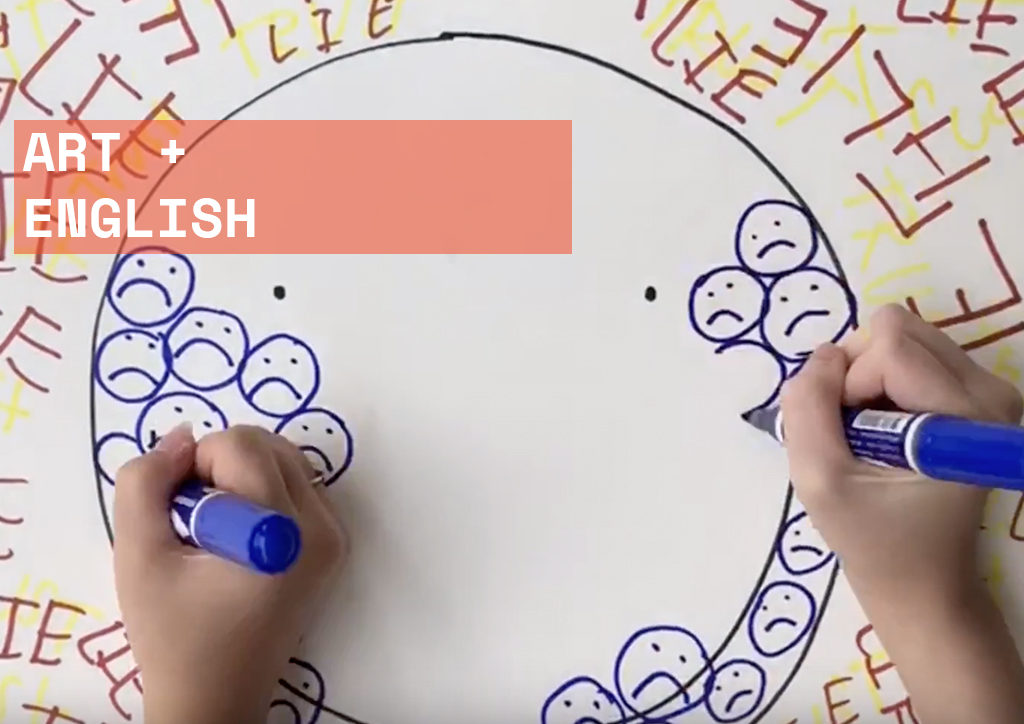
One of the core units explored within the visual arts curriculum is itself centered around the idea of collaboration. A project that the students have taken on within such a framework was an attempt at bridging concepts explored within their poetry unit in English class with the tools of visual communication they had gathered throughout their art studies.
Students were asked to each contribute a poem, or a sonnet for our use within the project. They were then paired up into small groups and worked toward selecting a poem of their liking together.
Secondly, students were asked to identify literary devices within the poems such as fragmentation, repetition, foreshadowing, metaphor, simile, etc. Next, students were reminded of the tools of visual communication they had acquired through their creative practice in art class such as line, texture, shape, color, pattern [and when using time-based media, speed and time]. We discussed how these devices of diverse disciplines might be paired, or complement one another. Could pattern represent repetition? How is color used as a metaphor for feelings/emotions? Can texture signify simile?
After discussion students were invited to utilize any materials available in the art room to create visual representations of their selected poems, ultimately producing video compositions. The only requirement given was that an audio component sharing the poem via spoken language be included within the video.
Students firstly worked in groups to deconstruct the poems via the literary devices they had learned in English class, and then reconstruct them visually via tools of visual communication. The results were works of video art where the visual imagery and spoken words complement one another and illustrate not only the results of the collaboration between these peers but also between disciplines and diverse forms of communication.
REFLECTION
My greatest surprise with this unit came in response to the effort that the students gave to the audio recordings of the poems incorporated into their video works. I fully expected that they would simply recite and record the poems as they were without much embellishment. On the contrary, many of the student groups turned the written poems into full-fledged songs, creating and performing their own musical recordings to back up the words that were often sung rather than spoken. On any given day in the art room we would have one group playing and recording a guitar while members clapped the beat aloud, another painting words to be used as lyrical symbols and another constructing precarious homemade tripods capable of capturing their movements as they ‘spelled out’ the meaning of the poems in colors and lines on the canvas set beneath. It was rewarding to see not only the great versatility that the students displayed in taking on a task through diverse media, but also how they could easily move from one form of communication to another, connecting the written and spoken word with images and sounds, seamlessly.