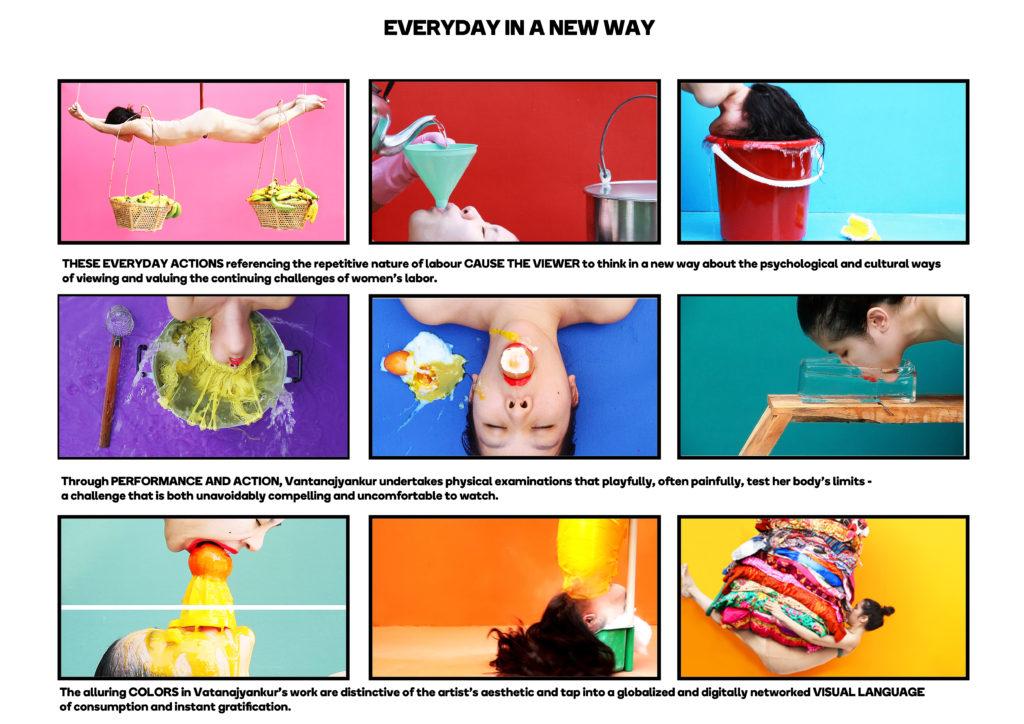
EVERYDAY IN A NEW WAY
In the third unit of the semester, the students welcome a visiting artist, Kawita Vatanajyankur, contemporary performance and video artist into our classroom and create a work of video art in response to her visit. The students work on utilizing performance and action as a means of communication, while also furthering their consideration for the audience and investigating the potential of art to nurture new forms of understanding within its viewers.
ESSENTIAL UNDERSTANDING
How can I utilize performance and action as tools of visual communication?
How can I create art that causes the viewer to think in a new way?
We begin the unit with an exercise exploring how we can utilize action as a means of communication, and the ways in which approaching something in an out of the ordinary manner might facilitate new understanding. Students are organized in a circle and presented with a bag containing a wide variety of different everyday objects. Students select one object from the bag and compose on a small piece of paper a one sentence response describing the typical action performed with this object. ie – ‘we use it to squeeze fruit into juice’ for an orange juicer, or ‘we use it to comb our hair’ for a brush. The one-sentence responses are collected and the objects go back into the bag. Next, the students are invited, one at a time, to select a new object from the bag and one of the written responses out of a bucket at random, essentially creating an out-of-the-ordinary pairing of an object and an action. Students work to ‘act out’ the written action with the new object and the student audience tries to guess what action is being performed.
This activity is not only fun but also gives the students a chance to both approach using action as a means of communicating and do so in a way that is unfamiliar/unconventional. The activity also welcomes the use of the English language in a manner that is spontaneous and unprompted as the students shout out their guesses as to what action is being performed.
CONTEMPORARY CULTURAL CONNECTIONS
Within the video art unit, we are offered the chance to welcome contemporary Thai artist, Kawita Vatanajyankur into our classroom. Kawita is an established member of the contemporary Thai art scene who has exhibited extensively both within Thailand and abroad. It is always an exciting day when she comes to share her work with the students and offers them the valuable opportunity to ask questions around her work and her experience working as a contemporary artist in Thailand.
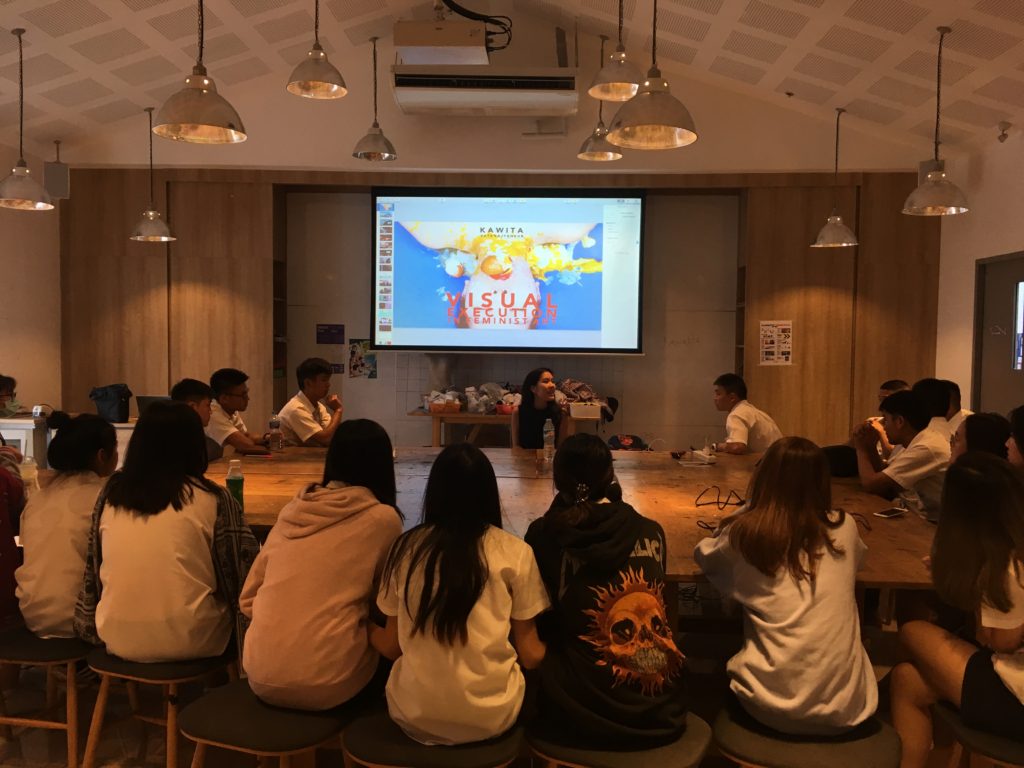
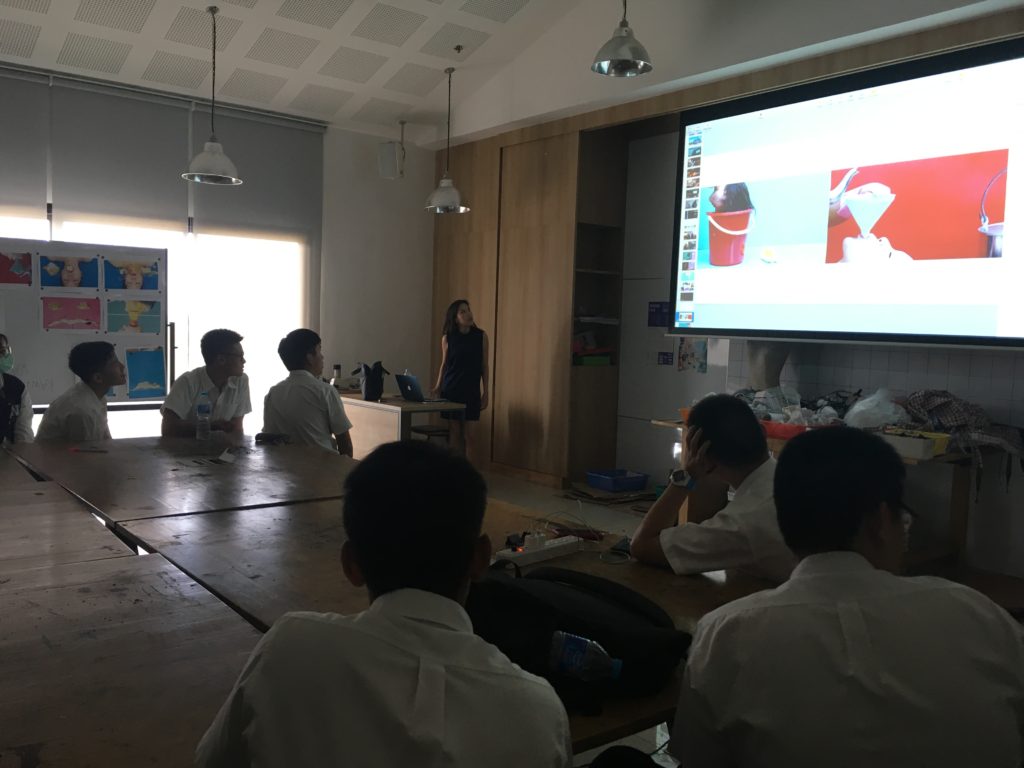
Following Kawita’s visit, students are invited to create their own works of video are aimed at utilizing performance and action to cause the viewer to think in a new way about the potential, result or potential of the action. Students are also encouraged to focus on an everyday action from their own teen lives, as a means of providing them with a framework to work within from which they speak in a genuine and authentic manner.
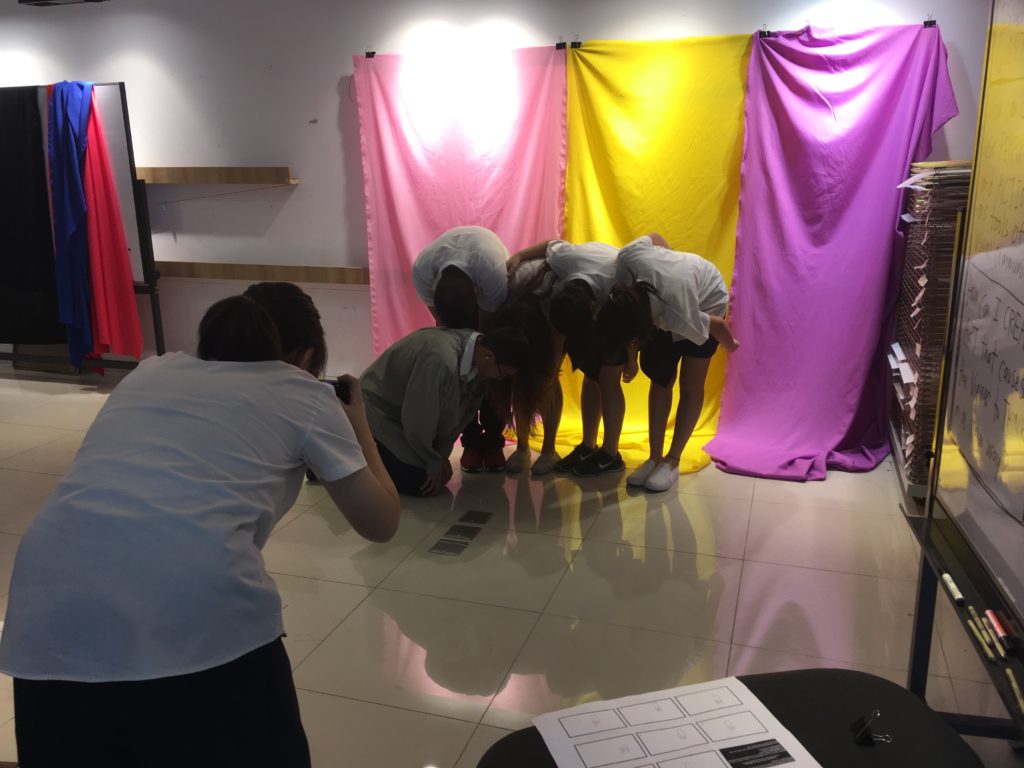
“This everyday action of teen life, interacting with peers, causes the viewer to think in a new way about the effects of technology on teenagers. In the past, children played with their friends outside on the playground. But nowadays, when technology has developed and phones are a part of everyday life, children stop playing with each other and only use their phones.”
This everyday action of teen life, listening to music on our headphones, causes the viewer to think in a new way about how using phones isn’t always a bad thing. Sometimes using our technology can help us to concentrate and to do better work and find happiness in a stressful situation.
This everyday action of teen life, studying for the SAT, causes the viewer to think in a new way about the real life of us seniors. In this video, I bring the SAT book everywhere I go to show that I am studying all the time to try and get a high score. But in the end, the result is not that good. All of the hard work I put in turns out to be useless so I just throw the book away and wish that I had given more focus to other parts of my life that are also important.
“This everyday action of teen life, “the controller,” causes the viewer to think in a new way about the importance of an unwilling choice and decisions. Actions and performance communicate how in a way we, teens, are forcefully controlled by someone or something.”
“This everyday action of teen life, changing emotions, shows that sometimes we cannot control our own feelings. Our emotions are affected by others around us and the situations that we face.”
“This everyday action of teen life, seeing things in a particular way through the media, causes us to think in a new way about the potential that the media has to shape our perceptions and opinions. The video encourages us to look at things objectively, and consider others’ points of view.”
“This everyday action of teen life, doing the same thing every single day, causes us to think in a new way about the repetitive nature of everyday life. When we do the same thing every day, does that lessen the value of living?”
Further questions the students consider within this unit include –
How can I utilize art practice to visualize an issue that has relevance to my own life? How can art practice broaden and diversify our understanding of our own world? How do diverse interpretations of a work of art strengthen or weaken its potential? Do works of art requiring a singular interpretation to succeed disregard the diversity of the viewers/cultures they encounter?